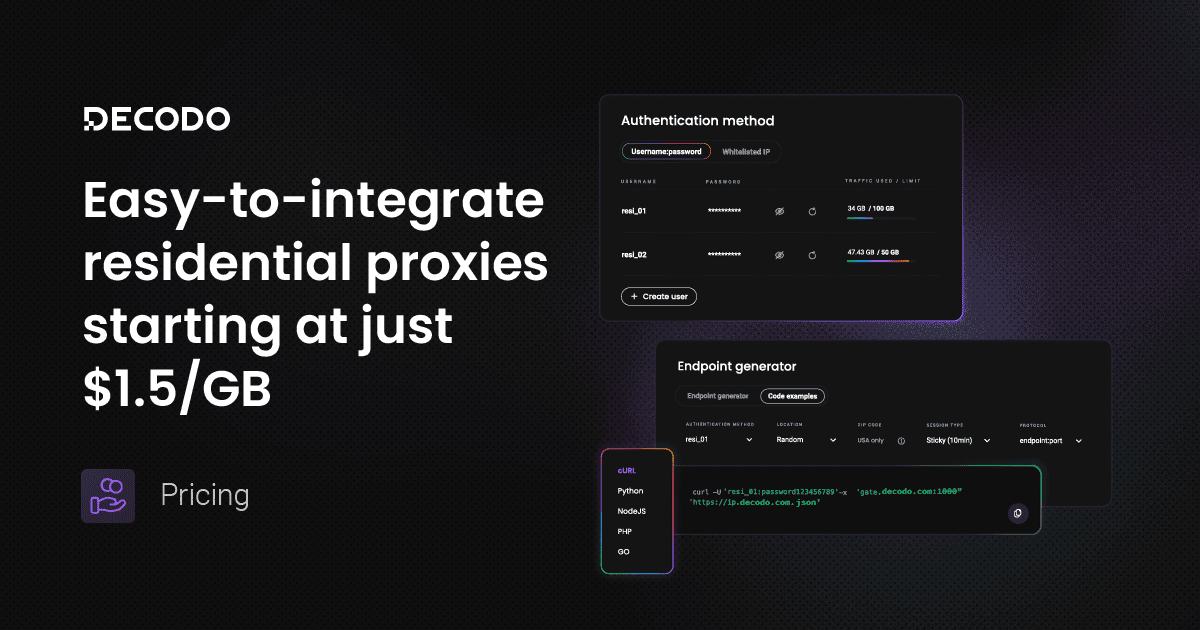

Decodo has become one of the most talked-about names in proxy infrastructure, especially after the Smartproxy-to-Decodo rebrand. If you are evaluating this provider in 2026, the real question is not whether the brand changed. The real question is whether the platform still delivers the same practical value for scraping, account operations, QA, geo-testing, and data collection workflows at scale. In this review, I break down the current Decodo product stack, pricing logic, performance expectations, support quality, and the trade-offs you need to understand before paying for a plan.
Decodo at a Glance
Decodo (formerly Smartproxy) is headquartered in Lithuania and offers four core proxy network families: residential, mobile, datacenter, and ISP proxies. The platform supports both HTTP(S) and SOCKS5, includes rotating and sticky sessions, and gives users granular geotargeting options. In practical terms, Decodo is trying to remain in the "premium-but-accessible" segment: more polished and predictable than many low-end providers, but still cheaper than the highest-priced enterprise proxy vendors in many entry configurations.
| Parameter | Decodo (Current Review Baseline) |
|---|---|
| IP Types | Residential, Mobile, Datacenter, ISP |
| Billing Model | Mostly traffic-based for rotating products, with product-specific models on other SKUs |
| Residential Starting Point | Pay-as-you-go from around $4 per GB (per the provided update brief) |
| IP Pool Claim | 125M+ (from update brief guidance) |
| Protocols | HTTP(S), SOCKS5 |
| Session Modes | Rotating, sticky sessions, static options (by product) |
| Targeting | Country, city, US state, ZIP, ASN (depending on product) |
| Auth | Username/password and IP whitelisting |
| Refund/Trial | 14-day money-back, trial options vary by product |
| Support | 24/7 live support plus email |
What Changed After the Rebrand
The most important update is naming continuity. Decodo is the new public brand, while many tutorials, old reviews, and forum posts still reference Smartproxy. Functionally, the platform lineage is continuous, but content updates matter because old claims are now inaccurate. In particular, some old sessions and discount claims are outdated. If you are comparing providers using cached review pages, double-check every number directly in checkout or product pricing pages.
Based on the update brief used for this article, the following corrections are important:
- Residential pay-as-you-go reference point updated to around $4 per GB.
- Sticky session durations can extend up to 24 hours, not only short intervals.
- Legacy "50% off" messaging should be removed.
- Current coupon guidance: DECODO5 for selected residential discounting and DECODO for broader product discounts.
- X Browser references should be removed from old content revisions.
Product Coverage: Residential, ISP, Datacenter, and Mobile
 Residential Proxies
Residential remains the flagship path for anti-bot-sensitive targets. If you run distributed data collection, ad verification, competitor monitoring, or region-specific content checks, residential generally gives the best balance between acceptance rate and setup simplicity. The platform‘s targeting filters are strong enough for most operational teams that need city-level routing and repeatable session behavior.
 Mobile Proxies
Mobile proxies are relevant when your workflow needs mobile ASN identity or a lower-friction identity class for sensitive environments. According to the update brief, the current mobile entry point starts from around $7.5 for 2 GB. That is notably different from several older articles that still quote much higher per-GB baselines. In practice, mobile should be used selectively because costs can rise quickly if you stream heavy pages or run long browser sessions without request discipline.
 Datacenter Proxies
Datacenter is still the lowest-cost engine for high-throughput tasks where target defenses are moderate or where your own anti-detection layer is mature. The updated brief references pricing that starts around $1.85 per IP in a 3-IP entry plan. Datacenter usually gives you better raw speed and lower unit economics, but the trade-off is higher detection pressure versus residential on stricter targets.
 ISP / Static Residential
ISP proxies are designed for stable identity over longer periods and are commonly chosen for long-horizon account workflows and repeated access tasks where sticky sessions are still too temporary. They are also useful when you need cleaner behavior than typical datacenter addresses while keeping better stability than rapid-rotation residential pools.
Session Control and Rotation Quality
Session behavior is one of Decodo‘s strongest operational points. You can run rotating mode for broader request distribution, or switch to sticky sessions for workflow phases that require continuity, cookies, or multi-step navigation. The update brief specifically calls out sticky durations from 1 minute up to 1,440 minutes (24 hours). That is a meaningful capability because many teams lose time when a provider forces short stickiness windows.
In real deployments, I recommend mapping session policy to task type:
- High-volume scraping bursts: short rotation, strict retry limits.
- Multi-step checkouts or account flows: medium-to-long sticky sessions with conservative request pacing.
- Persistent identity work: ISP/static products instead of overextending rotating pools.
Geotargeting Depth and Coverage
Decodo‘s targeting controls are broad enough for most commercial use cases. Country-level routing is standard, and for relevant products you can target city, U.S. state, ZIP, and ASN. For teams building QA matrices across regional storefronts, localized SEO snapshots, or ad creative validation, this granularity reduces manual overhead because you can keep one provider while scaling scenario coverage.
Targeting quality matters as much as proxy count claims. An IP pool number looks impressive on marketing pages, but your measurable success rate depends on whether the provider can consistently deliver the right geography with low mismatch rates. In my experience, Decodo performs well for mainstream geography demand, but as always, edge geos and niche ASNs should be tested before committing to larger plans.
Pricing Review and Cost Positioning
Decodo‘s price narrative has historically been "premium capability at lower entry cost." The latest revision brief preserves that positioning but updates many specific numbers. For this review baseline, the key guidance is:
- Residential pay-as-you-go starts around $4 per GB.
- Monthly residential bundles can reduce effective per-GB cost significantly (brief guidance includes lower per-GB tiers).
- Enterprise-style pricing can drop lower when volume and commitment increase.
- Datacenter and some rotating products have lower entry points than many old articles still report.
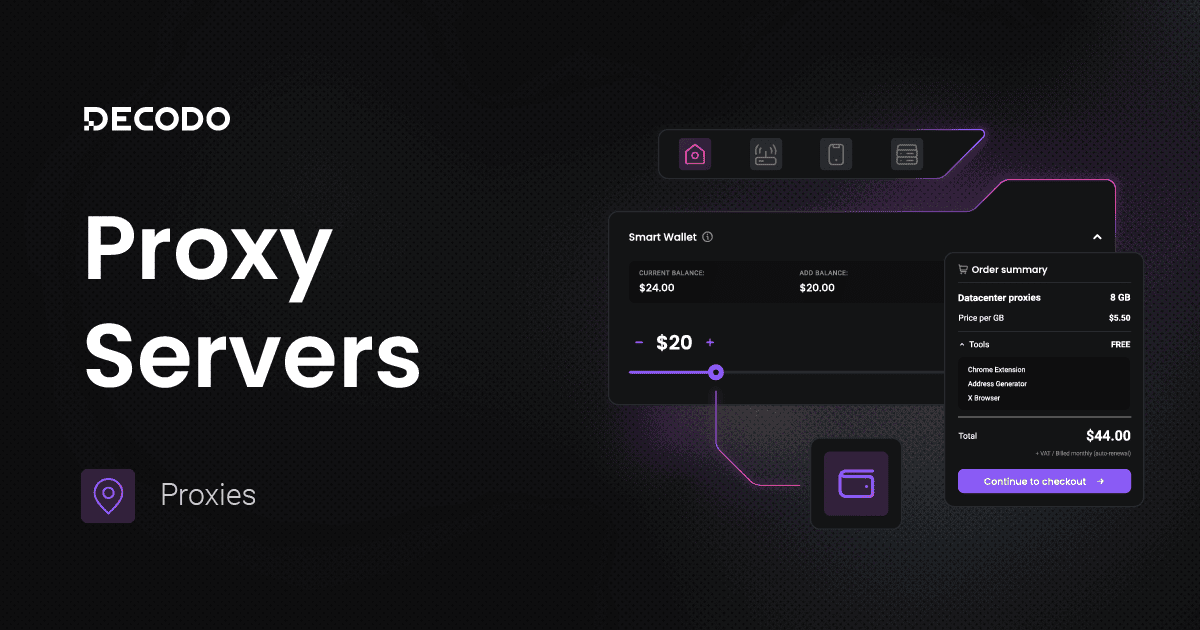
Cost evaluation tip: do not compare providers by headline "starting from" alone. Compare effective cost at your real throughput, request type, and required success rate. A cheaper per-GB line item can become expensive if retry volume spikes because of weak acceptance. Conversely, a slightly higher provider can become cheaper in net terms if pass rates are stronger and engineering overhead is lower.
Performance and Reliability in Daily Operations
Speed claims are easy to publish and hard to evaluate. Operational reliability is what matters: connection success, median response times under load, target acceptance rates, and error consistency. Decodo is generally considered reliable in this middle-to-high segment, especially for teams that need a practical dashboard, easy auth modes, and fast onboarding.
What I like is that Decodo does not force overly complex integration for standard workflows. You can start quickly with username/password auth, then move to IP whitelisting for stricter internal controls. The platform can support both lightweight scripting and more structured proxy orchestration pipelines.
Where teams still fail is process, not provider choice: no request budgeting, no failure categorization, and no product-task mapping. If you point all workloads at one proxy type without segmentation, your performance conclusions will be noisy and often wrong.
Support, Trial, and Risk Controls
Support quality is often ignored in comparison tables, but it becomes decisive when production jobs start failing. Decodo offers 24/7 support plus email channels, and historically this has been one of its practical advantages for teams that cannot tolerate long debugging cycles. The platform also advertises refund and trial structures, but the exact terms can vary by product family and billing structure, so read current checkout terms before purchase.
From the update brief for this article, the recommended user-facing promo guidance is:
- DECODO5: selected discounting for residential proxy plans.
- DECODO: broader discounting across Decodo products.
Always verify active coupon terms before publishing a final buying guide because promo mechanics can change faster than technical product capability.
Who Should Use Decodo
Decodo is a strong fit if your team wants one vendor that can cover multiple proxy types without a heavyweight enterprise procurement process. It is especially useful when you need to move between residential, mobile, datacenter, and ISP use cases while keeping a consistent management experience. If your workloads are mixed and you prefer operational simplicity over ultra-custom vendor specialization, Decodo is a practical choice.
It may be less ideal if your only requirement is the absolute lowest raw price with no need for support quality or fine-grained targeting. In those cases, budget-only alternatives can look attractive, but you should evaluate hidden costs from lower success rates and higher maintenance.
Pros and Cons
Pros
- Broad product portfolio across major proxy categories.
- Strong geotargeting controls (country, city, state, ZIP, ASN on relevant products).
- Flexible session model including long sticky windows.
- Competitive entry pricing relative to many premium competitors.
- 24/7 support and straightforward onboarding flow.
- Rebrand continuity from Smartproxy is now clearer for new users.
Cons
- Old internet content is full of outdated Smartproxy-era pricing and promo claims.
- True cost still depends heavily on workload design and retry behavior.
- Some advanced teams may still prefer specialized vendors for narrow edge-case workloads.
Editorial Notes on Compliance and Use Cases
When reviewing proxy services, avoid framing around restricted or non-compliant use cases. The right way to evaluate Decodo is through legitimate operational workloads: public data collection with policy compliance, localized QA, uptime and content verification, market intelligence gathering within legal boundaries, and internal automation where proxy identity control is required. Keep this boundary explicit in your own team documentation and client-facing deliverables.
Final Verdict
Decodo remains one of the better balanced options in 2026 for teams that need a real proxy stack rather than a single "cheap IPs" product. The platform combines breadth (residential, mobile, datacenter, ISP), decent control (sticky/rotating sessions and geotargeting), and practical support quality. The biggest risk is not product weakness; it is decision-making based on outdated Smartproxy-era articles. If you are willing to validate current pricing at checkout and match each workload to the right proxy family, Decodo is absolutely a provider worth shortlisting.
For most operators, the next step is simple: run a controlled pilot with your own targets and track real success metrics for 7 to 14 days before scaling. If acceptance rates and cost efficiency line up with your internal thresholds, Decodo can be a reliable long-term component in your proxy stack.
Get Decodo with Active CouponFAQ
Is Decodo the same company as Smartproxy?
Yes. Decodo is the new brand identity. Many older references still use Smartproxy, so verify the date of any review you read.
What is the best Decodo product to start with?
For most mixed workloads, residential is the safest starting point. Move to datacenter for cost-sensitive high-volume tasks and to ISP/static products for longer identity persistence.
Does Decodo support long sticky sessions?
Yes. The current update brief for this article indicates sticky session control up to 24 hours, depending on configuration and product path.
Which coupon code should I use?
Current guidance for this review: use DECODO5 for selected residential plans and DECODO for broader Decodo product discounts, then verify active terms before checkout.
Should I trust old Smartproxy pricing screenshots?
No. Pricing and promotions have changed. Use official Decodo product pages and current checkout totals as your final source of truth.